Learning Struggles in Children: Look Beyond the Behavior | Roots to Reason
Speech-language pathologist Rebecca Iwanczyk explains how underlying cognitive and learning challenges can affect behavior, confidence and academic performance.

How getting to the root of learning challenges can change the way children see themselves—and what becomes possible.
BONUS: Scroll to the bottom to see special offer from Speech Language Reading Center in Hixon, Tennessee.
When a child struggles with reading, writing, spelling, math, attention, or following directions, it can be easy to focus on what we see: frustration, avoidance, poor grades, resistance, or behavior that looks like a lack of effort.
But what if the behavior isn't the problem?
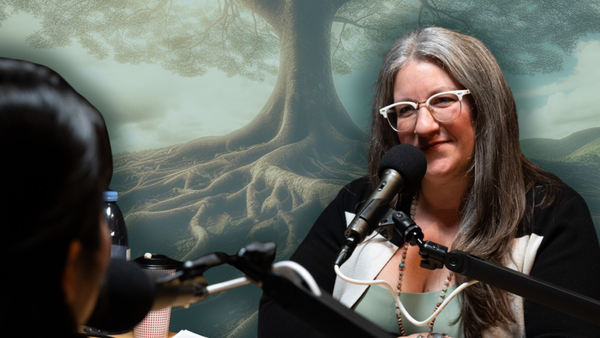
In Episode 6 of Roots to Reason, host Michelle Hecker Davis sits down with Rebecca Iwanczyk, a speech-language pathologist with more than 20 years of experience and owner of the Speech Language Reading Center in Hixson, Tennessee.
Their conversation explores what can happen when we stop asking why a child isn't trying harder and begin asking a much more useful question:
What's actually making this difficult for them?
Getting to the Root of a Learning Struggle
For Rebecca, identifying the underlying issue is essential to creating meaningful, lasting progress.
“If you can get to the root, then we can really make that lasting change.”
A child's academic performance doesn't exist in isolation. Skills such as working memory, processing speed, visual-spatial abilities, and vocabulary can all influence how a child performs in reading, spelling, written expression, math, and other areas of learning.
That means a child who appears distracted, resistant, or unmotivated may actually be working incredibly hard to compensate for an unidentified area of difficulty.
And when those difficulties aren't understood, the consequences can reach far beyond a report card.
When “Try Harder” Becomes Part of a Child's Identity
One of the most important ideas in this episode is the emotional impact of an unidentified learning challenge.
A child who repeatedly struggles may hear that they aren't trying hard enough. They may watch classmates accomplish things that require considerably more effort for them. Eventually, that experience can begin to shape how they see themselves.
They may start wondering whether they simply aren't smart.
Rebecca offers an important counterpoint:
“Oftentimes these kids are so smart.”
The challenge may not be intelligence at all. Understanding a child's cognitive and academic strengths and weaknesses can give families a very different explanation for what they're seeing—and give the child an opportunity to understand themselves differently, too.
Instead of simply identifying what isn't working, thoughtful evaluation can help reveal why it isn't working and where the child's strengths can help support progress.
Testing Can Help Connect the Dots
During the conversation, Rebecca explains how evaluation can look at both cognitive abilities and educational performance.
That can include areas such as working memory, processing speed, visual-spatial skills, and vocabulary alongside reading, math, spelling, and written expression.
Information from parents and teachers can add another important layer. Looking across these different areas can reveal discrepancies that may help identify a learning disability or clarify why a child is struggling in a particular environment.
The goal isn't simply to give a difficulty a name.
It's to better understand the individual child.
The Right Support May Require More Than One Perspective
Rebecca also emphasizes another principle at the heart of her work:
“Collaboration. That is key for me.”
The Speech Language Reading Center primarily works with children and young adults ages 3–21, but addressing an individual's needs may involve expertise extending beyond speech and language services.
Depending on the child, that can mean connecting and collaborating with professionals in occupational therapy, physical therapy, counseling, neurofeedback, reading, dyslexia support, and other specialties.
Rather than expecting one provider or one intervention to solve every problem, Rebecca emphasizes helping families find the support that fits the individual.
It's an approach that closely reflects the philosophy behind Roots to Reason: follow the clues, ask better questions, and look beneath the surface.
What Parents and Caregivers Can Take Away
Perhaps the biggest lesson from this conversation is that struggle is information.
When a child continually has difficulty in a particular area, the answer isn't always more pressure, more practice, or another reminder to “try harder.”
There may be a reason the task is difficult.
Finding that reason can change the intervention—but it can also change the story a child tells themselves about who they are and what they're capable of doing.
For parents, caregivers, and educators, that makes curiosity incredibly powerful.
Before assuming unwillingness, ask what might be getting in the way.
Before focusing exclusively on performance, look at the skills required to produce that performance.
And when one perspective doesn't fully explain what's happening, collaboration may help connect the missing pieces.
Offer from Our Guest to You
$100 OFF evaluation with Speech Language Reading Center. Mention Roots to Reason when you make your appointment.
About Rebecca Iwanczyk
Rebecca Iwanczyk is a speech-language pathologist with more than 20 years of experience and owner of the Speech Language Reading Center in Hixson, Tennessee. Her work centers on understanding each individual's needs, identifying underlying challenges, building on strengths, and connecting families with appropriate resources and providers.
Listen to Episode 6
Hear the complete conversation with Rebecca Iwanczyk on Roots to Reason and discover why getting to the root of a child's struggle may be one of the most important steps toward helping them thrive.
Roots to Reason is hosted by Michelle Hecker Davis and explores vital optional therapies, cognitive science, integrative health, functional medicine, and the people asking better questions about how we learn, heal, and thrive.
Powered by Chattanooga LearningRx and produced by Nooga Podcast Network.